Proactive, not reactive
We are investigating ways to make user-controlled check-ins easier. The concept does not claim to detect crisis, replace human support, or intervene automatically.
Whistlebox Guardian is a concept and prototype exploring how selected wearable APIs could support user-controlled wellbeing check-ins. It is not a medical device, crisis detector, emergency service, or endorsement by any device maker or public agency.
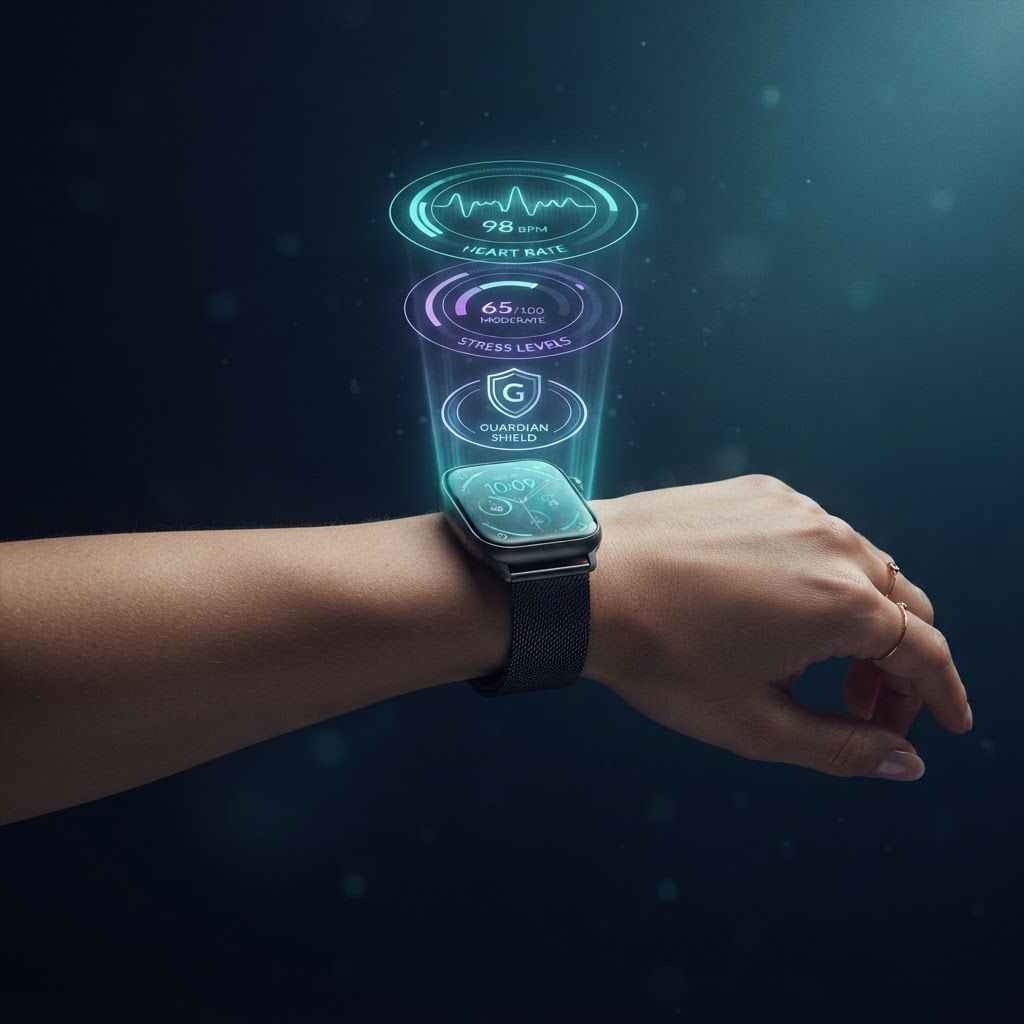
The module catalogue is a vision and discovery tool. It helps partners discuss possible use cases; it is not evidence that these modules are built, deployed, clinically validated, or connected to emergency services.
A proposed flow for a future product, subject to technical feasibility, user research, safety review, consent, and partner validation.
Designed to integrate with selected wearable APIs where access, permissions, data quality, and partner agreements allow. No universal compatibility or automatic discovery is claimed.
A future research direction is to assess user-selected signals and patterns. The concept does not diagnose, predict crisis, measure cortisol, or claim clinical performance.
A future design could offer user-selected prompts, check-ins, or agreed escalation pathways. It must not remove consent, replace professional care, or imply a connection to 1737 or emergency services without a written agreement and validated operating model.
The intended direction is privacy- and consent-led design. Compliance, cultural safety, security controls, and data governance require formal assessment and cannot be claimed as complete on this page.
Examples shown are ecosystem references, not confirmed integrations, endorsements, or compatibility claims. Any integration would depend on API access, consent, technical testing, data governance, and a partner agreement.
Whistlebox Guardian began with a simple insight: We are exploring whether a consent-led digital layer could support earlier, user-controlled wellbeing check-ins. This is a product vision, not a claim about existing services, outcomes, or a relationship with 1737.
Our proposed response layer would be designed for user-selected signals and explicit consent. Any wellbeing or safety use would require research, partner validation, clinical and safety review, and culturally grounded engagement in Aotearoa.
We are investigating ways to make user-controlled check-ins easier. The concept does not claim to detect crisis, replace human support, or intervene automatically.
Designed to integrate with selected wearable APIs, subject to access, testing, consent, data governance, and partner approval. No endorsement or compatibility is implied.
Privacy and consent are design requirements. Formal compliance with applicable privacy and health-information obligations is not yet claimed.
Potential public-sector and service-provider partnerships are exploratory only. Health New Zealand, 1737, government agencies, Apple, Google, Oura, Meta, and other named organisations do not endorse this concept unless separately confirmed in writing.
Proposed MVP: a consent-led check-in experience that accepts a limited set of user-selected signals from a selected integration, shows the user what was received, and records an explicit choice about next steps. It would be tested in a defined environment with clear stop criteria.
Consent capture, selected signal ingestion, user-visible status, configurable check-ins, audit-friendly event logging, and a partner-defined pilot evaluation.
No diagnosis, crisis prediction, emergency dispatch, clinical efficacy, universal device support, or production uptime is claimed.
Data quality, user comprehension, consent durability, safe failure behaviour, accessibility, and partner-defined outcomes—not invented live counts.
A strategic direction and partner conversation, not a deployed capability.
Interactive UI and simulated telemetry for product discussion. It does not authenticate, monitor real people, or represent live operations.
Capabilities will be labelled validated only when reproducible evidence, consent, governance, and an accountable test environment are available.
The public partnership form collects contact and organisational details only. It does not ask for health information. A future pilot would need a documented purpose, data minimisation, clear user choices, retention rules, access controls, security review, and an appropriate privacy assessment before collecting sensitive data.
Users should understand what signal is used, why it is used, who can see it, and how to stop sharing.
We will separate technical feasibility, usability evidence, safety evidence, and clinical evidence rather than treating one as another.
Any service, public-sector, device, or community relationship must be agreed directly and represented accurately.
This concept is not an emergency service. A future pilot would need human oversight, explicit escalation boundaries, safe failure modes, accessibility review, safeguarding expertise, and clear directions to appropriate local support. No automatic escalation to 1737, emergency services, employers, insurers, or family members is active or implied.
Whistlebox Guardian is designed by Ace Lio. Advisors, clinical reviewers, cultural advisors, technical partners, and pilot organisations will be named only with their consent and after their roles are confirmed.
Not yet claimed as built: production wearable integrations, validated signal models, clinical or crisis-detection performance, emergency-service routing, partner endorsements, live fleet telemetry, production security certification, and a deployed public-sector operating model.
We are seeking conversations with research, technology, service, community, cultural, funding, and evaluation partners. The immediate ask is discovery: test the problem, challenge the assumptions, and define evidence that would justify a next step.
Request a conversationWe welcome conversations with organisations that can help test the problem, define a responsible MVP, and validate technical, safety, privacy, and partnership assumptions. No market size, revenue forecast, deployment, or funding figure is presented here as validated.
For SponsorsExplore a scoped discovery or pilot conversation; no grant relationship is claimed.
For GovernmentDiscuss potential service pathways only with the relevant organisations; no integration or endorsement is claimed.
For InvestorsReview an evidence-based roadmap and partnership model as they are validated; no forecast is presented as fact.
Camera eye-scan demonstration. Allow camera access, then blink or move gently to simulate a liveness signal.
Demo only: this camera motion check does not identify your eyes, prove ownership, or protect Mission Control. Do not deploy this variant for real security.
Demonstration mode only. This camera motion check is not owner authentication and must not protect a live Mission Control deployment.
Illustrative device rows; no production devices are connected.
| Device | Type | Module | Status | Heart Rate | Stress | Battery | Location | Action |
|---|
Illustrative alert-routing interface; no emergency routing is active.
Illustrative module controls for a simulated environment; no production mesh is connected.
Configure platform security and SMTP integration.